
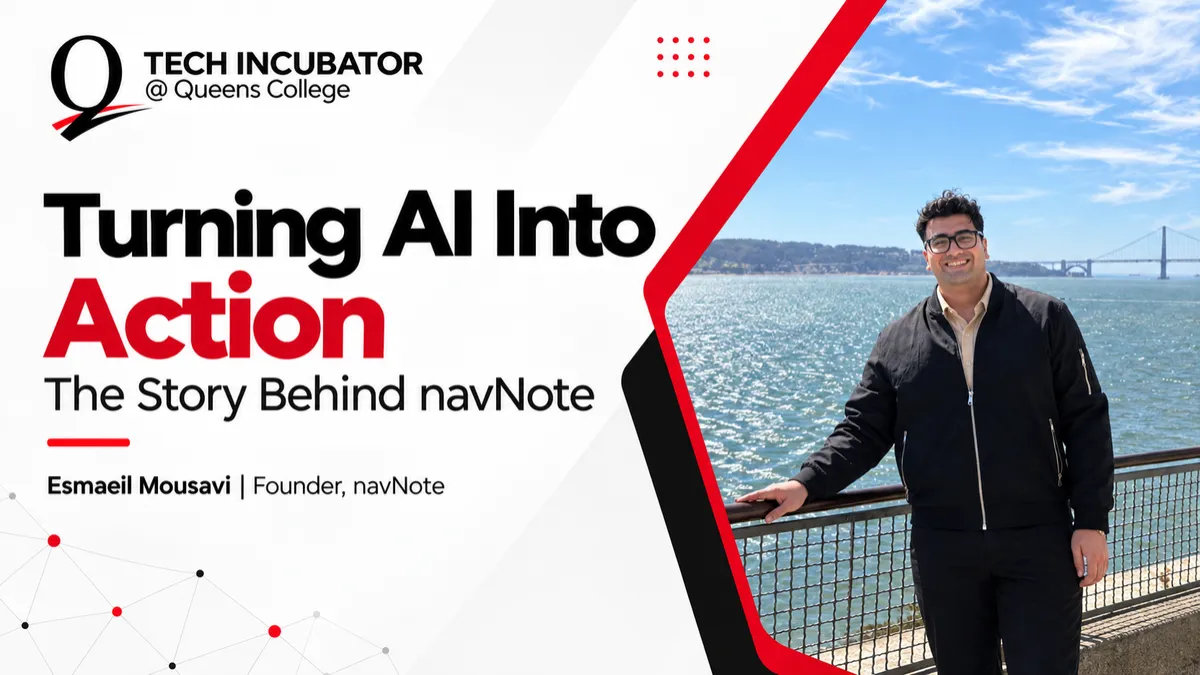
Turning AI Into Action:The Story Behind navNote
For Esmaeil Mousavi, the future of artificial intelligence is not just about building smarter models. It is about understanding what is happening in the real world and using that intelligence to help people take action.
That idea is at the heart of navNote, an AI operations platform designed for grocery and retail stores. Every day, store teams manage hundreds of tasks, from checking shelves and restocking products to auditing prices, correcting planogram errors, managing backroom inventory, reducing waste, and coordinating across departments. Yet much of this work still relies on paper lists, radios, spreadsheets, and disconnected systems.
navNote is designed to bring these processes together. Its platform combines a mobile app for store associates, a real-time operations cloud, and tools for managers and executives. Behind the scenes, AI agents use the stored data and digital twins to understand what is happening, identify problems, assign tasks, and help teams respond more quickly. Through work with NVIDIA and mimik Technologies, the company is also exploring ways to run AI locally and on-premise, with the goal of improving speed, reliability, privacy, and reducing dependence on continuous internet connectivity.
Esmaeil’s journey to navNote began long before the company itself. Growing up in Iran, he studied at the National Organization for Development of Exceptional Students (NODET) and filed his first international patent application at just 17. After moving to the United States at 19, he studied computer science at Weber State University, where he met his future co-founder, Niklas Kennedy. At the time, Niklas was president of ACM while Esmaeil was a senator for the College of Engineering. Their shared interests quickly turned into a friendship and eventually a business partnership.
While still in college, Esmaeil worked as a research and teaching assistant and helped develop a graduate-level course focused on autonomous vehicles and systems. That experience led him to think about how the intelligence used in autonomous systems could be applied beyond vehicles and into physical business environments.
Together, Esmaeil and Niklas began exploring industries such as grocery, retail, warehouses, and manufacturing. They saw that these businesses generate enormous amounts of data, but there was still a gap between knowing what was happening and actually coordinating the work needed to respond. That gap became the foundation for navNote. The two founders even drove across the country together, visiting stores, meeting operators, and learning directly from the people working in these environments.
Finding the right direction was not immediate. Large retailers already use sophisticated systems for forecasting, sales analytics, inventory, and other functions, but Esmaeil noticed that many of these tools primarily explain what happened or what should happen. They do not necessarily coordinate and execute the work happening on the store floor.
That led to a series of questions: Could software identify a missing product on a shelf? Detecting a pricing error? Check planogram compliance? Understand what is happening in the backroom? Assign the right employee to a task? Connect different departments and help coordinate with vendors?
Answering those questions required experimentation. The team tested ideas, changed direction, spoke with operators, visited stores, and experienced plenty of failures along the way. One of the biggest lessons was the importance of staying close to the customer. Spending time inside stores and watching how people actually worked revealed much more than assumptions made from a conference room ever could.
Esmaeil’s relationship with the Tech Incubator at Queens College (TIQC) is also becoming an important part of that journey. Through TIQC, he has connected with a community of entrepreneurs, mentors, and professionals while learning more about the incubator’s work supporting startups, market research, and hands-on opportunities for Queens College students. His work with Dr. Ying Zhou has been particularly valuable as he explores opportunities to connect navNote with researchers, students, and the broader TIQC community.
He sees potential for that collaboration to extend beyond entrepreneurship. As AI continues to evolve rapidly, Esmaeil believes companies need both real-world experience and serious research to build useful technology. He is particularly interested in opportunities involving AI, enterprise operations, market research, and understanding evolving customer needs.
For other founders entering the AI industry, Esmaeil emphasizes learning directly from the field. One phrase that guides his thinking is, “Knowledge is the reverse engineering of nature.” Rather than spending all of their time in meetings or building in isolation, he encourages entrepreneurs to spend time where their customers actually work. He also believes founders should test their ideas early, sell before a product is perfect, and avoid over-engineering the first version.
His own experience has reinforced the importance of being willing to change direction. Building navNote has involved pivots, experiments, and failures, but each one has provided information that helped shape the company. Esmaeil believes founders need the confidence to fully commit once they make a decision, while also having the discipline to change course when evidence points toward a better path. He also encourages new entrepreneurs to seek mentors who have actually done the work, whether they are AI leaders, industry operators, entrepreneurs, or other experienced professionals.
Today, navNote is focused on expanding beyond its first live customer and working with additional regional grocery and retail chains. The company is also developing its security and compliance infrastructure to prepare for larger enterprise deployments. Food waste and shrink are additional areas of long-term interest, with the team exploring potential collaboration with organizations such as IGD and other industry groups.
Beyond navNote, Esmaeil is also working with researchers and scientists from several institutions on an AI manifesto exploring his personal and professional perspectives on the evolution of artificial intelligence and its role in human life. One concept emerging from this work is what he calls “Small Expert Agents” which means networks of smaller, highly specialized AI agents working together rather than relying on one general-purpose model for every task. He sees potential for these systems to operate locally or on-premise, closer to the physical environments where decisions actually need to be made.
From autonomous systems to retail operations, Esmaeil’s journey reflects a broader idea: AI becomes most useful when it can move beyond simply understanding information and help people act on it. Through navNote, he is working to bring that idea into one of the most complex physical environments - the everyday retail store, while continuing to explore what the next generation of intelligent systems could look like.
Learn more about Esmaeil Mousavi and navNote:
Personal Website: esmaeil.org
navNote: navnote.ai
navNote Updates: navnote.ai/updates
LinkedIn: linkedin.com/in/mousavi-ai/