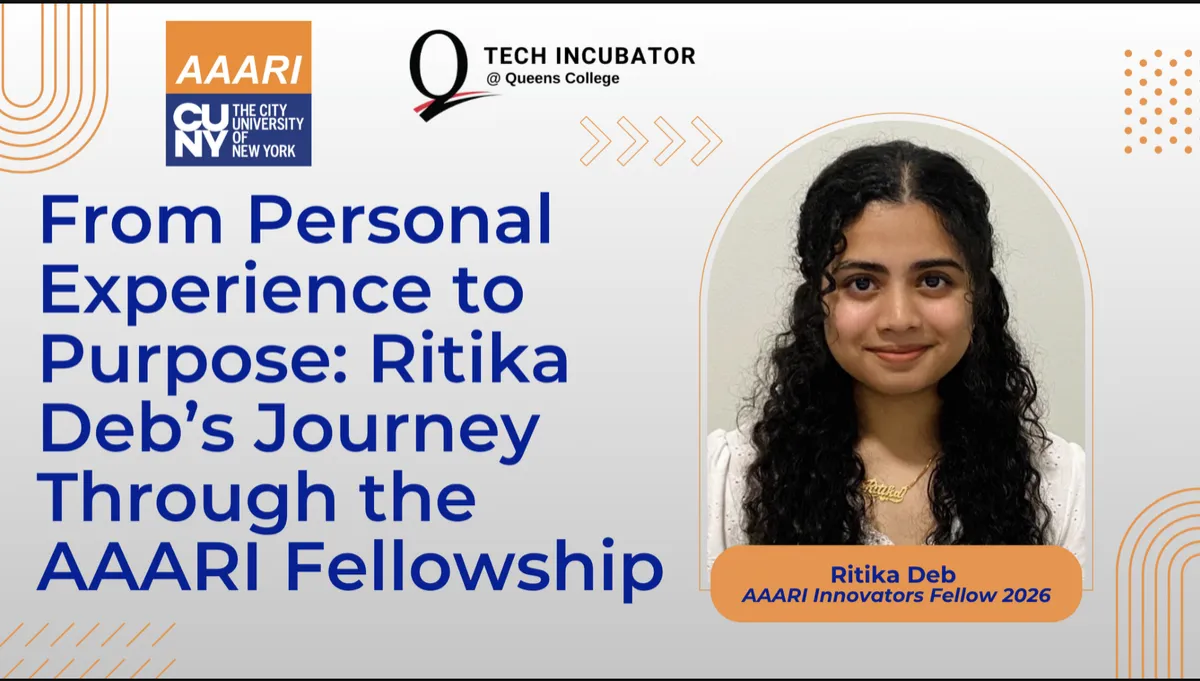
From Personal Experience to Purpose: Ritika Deb’s Journey Through the AAARI Fellowship
When Ritika Deb first joined the AAARI Fellowship at the Tech Incubator at Queens College (TIQC), she was still finding her footing in computer science. What she did have was a personal connection to a problem she had seen for years: the language barriers faced by South Asian women in her community.
Ritika, a sophomore at Queens College, immigrated to the United States from Bangladesh when she was around nine years old. Outside of her studies, she enjoys dancing, photography, and food journaling. Her interest in the AAARI Fellowship came from wanting to better understand issues affecting Asian American communities in New York City, particularly communities that she felt were sometimes left out of conversations around poverty and educational inequality.
The issue became especially personal when she thought about her mother and other South Asian women in her community. Many women, she noticed, struggled with language barriers that made it harder to communicate and participate independently outside the home. Ritika watched her own mother struggle to form sentences and hold conversations in English, eventually becoming hesitant to speak it altogether. She began noticing similar experiences among other women around her.
At the same time, Ritika noticed something else. These women often found ways to connect with one another, including talking over the phone while doing everyday activities like cooking. As conversational AI tools became more accessible, Ritika and her team began wondering whether they could combine that technology with something familiar and comfortable to create a practical way for women to practice English.
That idea became EasyPeasy, an AI-assisted language-learning app designed specifically with South Asian women homemakers in mind. The name itself is a little playful, inspired by the way South Asians often enjoy adding rhymes to their everyday expressions.
Ritika played an important role in shaping the app’s features, layout, and overall user experience. She also brought her interest in presentations and design to the project, helping develop an aesthetic and color palette that reflected the different cultural identities represented on the team.
The project gave Ritika an opportunity to work with technology in a way that was directly connected to people’s everyday lives. It also introduced her to parts of the product development process that she had not experienced before.
Her experience as an AAARI Fellow has been especially meaningful because of the people around her. Working with teammates and mentors gave her the chance to learn about different software and technical processes while also developing skills outside of coding. One of those opportunities came when her team presented their product pitch at 1 Million Cups, giving Ritika a chance to practice communicating an idea clearly to an audience from different backgrounds.
She describes the AAARI community as welcoming and encouraging — a place where she was pushed to challenge herself while still having people willing to support her along the way.
Teamwork was another important part of the experience. Ritika remembers brainstorming as one of her favorite parts of the process. Ideas came from everyone, and although the team couldn’t incorporate every suggestion, each conversation helped them understand what belonged in the app and what might make the experience feel cluttered. She credits her teammates, Lhakpa and Abdur, for being patient and encouraging throughout the process.
The team hopes to continue developing EasyPeasy and eventually expand it to include more languages. For Ritika, that goal is especially important because of the diversity within New York City’s South Asian community. A tool designed to support one group of users can look very different when it is adapted to the languages and experiences of others.
Beyond the project itself, the AAARI Fellowship and TIQC have helped Ritika grow more confident in both her technical and professional abilities. Her work on client-related projects exposed her to areas such as data analytics and encouraged her to pursue her own research. The AAARI Fellowship introduced her to foundational business concepts and taught her how to create and present a professional pitch deck.
Most importantly, she says these experiences helped her understand the value of clear communication and maintaining a growth mindset.
Her advice to other students considering the AAARI Fellowship or TIQC Internship is simple: don’t be afraid to reach out.
Ritika says she might never have discovered these opportunities if she hadn’t reached out to people such as Nouhayla and Ying, who were willing to share information and point her toward new experiences. The same approach helped her connect with other interns and learn about different career paths, research opportunities, and scholarships.
Sometimes, she says, one conversation can lead you somewhere you never expected to go.
Ritika joined TIQC still unsure of exactly what career path she wanted to pursue. Through the people she met, the projects she worked on, and the ideas she was able to explore, she has started building a clearer sense of what is possible.
Her experience with EasyPeasy is a reminder that technology projects don’t always begin with a technical problem. Sometimes they begin with noticing something happening in your own home or community and asking a simple question: Could there be a better way?
For Ritika and her team, that question became the starting point for building something that could help people feel more confident, connected, and independent.
Reach out to Ritika: Linkedin